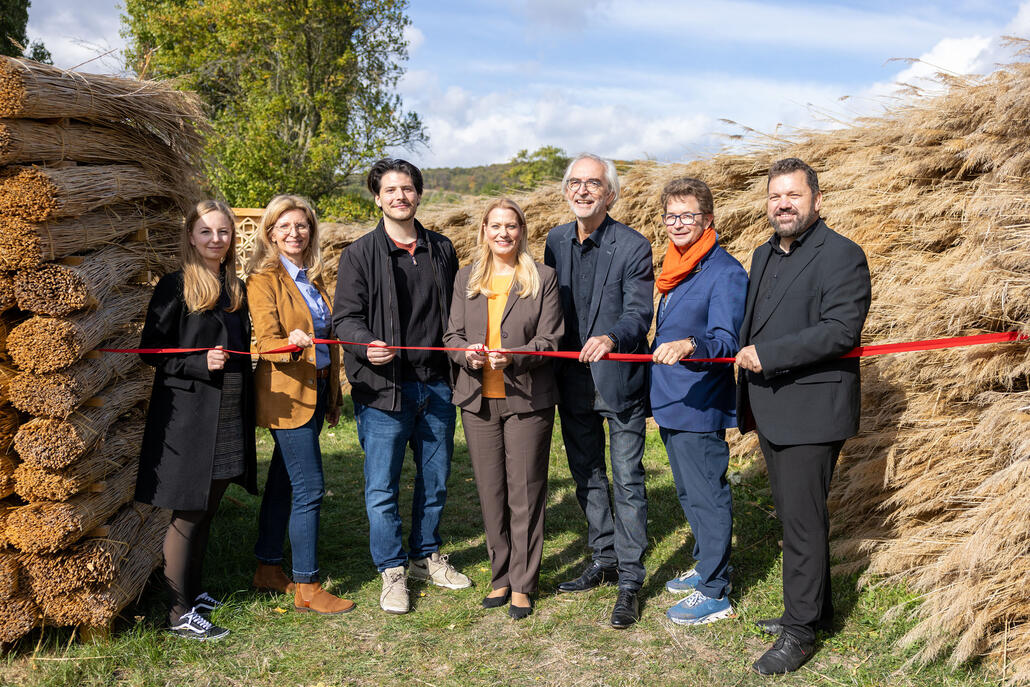
“Our approach is to view the reeds and sediments of Lake Neusiedl not as waste, but as a valuable regional resource, and to develop new opportunities for their sustainable use,” explained Martin Zloklikovits, Managing Director of Forschung Burgenland. One result of this research collaboration is now on display at the Wander Bertoni Open-Air Museum in Winden am See: a walk-in ‘reed room’ has been created from sediment and reeds. “As someone who comes from the region myself, I know how closely Lake Neusiedl is linked to our landscape, our identity and our lives. At the same time, we face the challenge of managing our region’s natural resources responsibly and sustainably. With the ‘Reed Room’ project, we are demonstrating that even materials that have been little used to date, such as the sediment from Lake Neusiedl, hold great potential,” emphasised Provincial Councillor Daniela Winkler.
“I am particularly pleased that the collaboration between Forschung Burgenland, Seemanagement Burgenland and Graz University of Technology has turned an idea for a circular economy into a concrete, innovative research project. The ‘Schilfraum’ project impressively demonstrates how regional resources, science and young, creative minds can work together to open up new perspectives for sustainable construction and regional value creation,” said Winkler.
When people talk about research and innovation, many initially think of laboratories, high-tech and new technologies. “For us at Forschung Burgenland, however, innovation often begins with a simple question: what resources do we have right on our doorstep, and how can we make better use of them? It was precisely this question that marked the start of this project,” reported Zloklikovits.
This line of thinking led to a research collaboration with Seemanagement Burgenland, Graz University of Technology and Ceramico Burgenland. The research investigated how sediments could be used as raw materials for new building materials: “What’s particularly exciting is the use of modern manufacturing technologies such as 3D printing, which combines regional raw materials with innovative materials research. “What pleases me most is how this original research question has developed into something much bigger,” emphasised the Managing Director of Forschung Burgenland.
Through collaboration with the Institute of Architecture and Media at Graz University of Technology and the involvement of students, the material experiments ultimately gave rise to the ‘Reed Room’. This succeeded in bringing research out of the laboratory and making it visible and tangible for people to experience. The installation demonstrates the potential of reeds and sediment, and what can be achieved through collaboration across different disciplines.
One key starting point is the EU Interreg research project REVALUE, which aims to develop innovative solutions for the recovery of previously problematic municipal material flows and to promote greater material circularity in cross-border regions. As part of the project, new recovery approaches for regional waste materials and potential applications for sustainable products and building materials are being investigated.
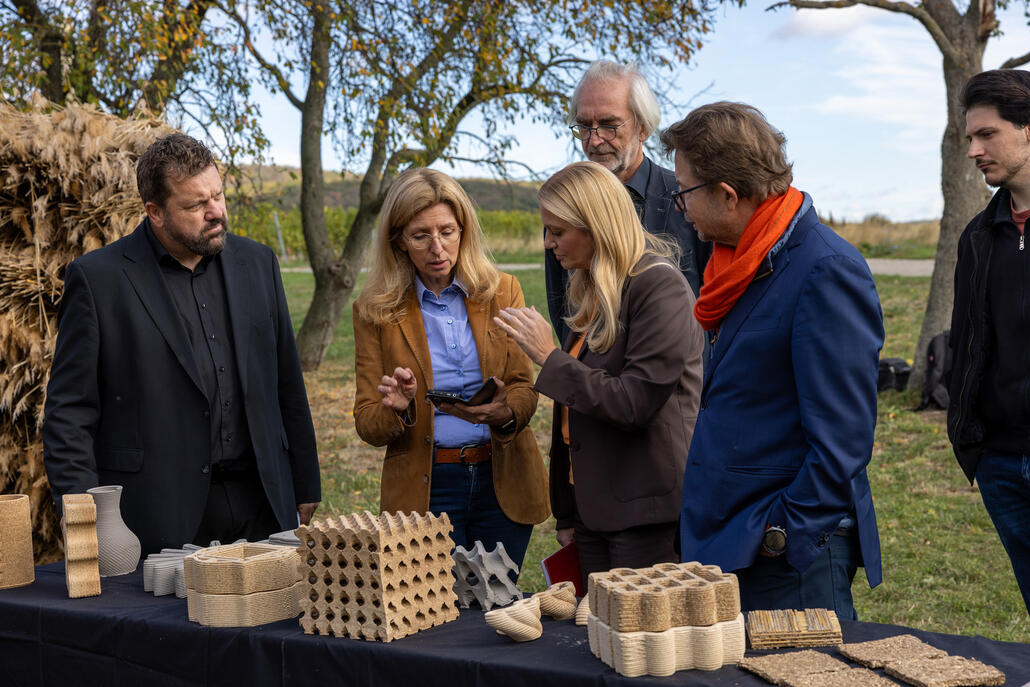
One innovative approach involves processing the material using 3D printing. At the Institute of Architecture and Media at Graz University of Technology, the sediment was prepared for digital fabrication in the ShapeLAB. Various material mixtures, printing parameters, geometries and wall structures were tested. The investigations focused, amongst other things, on drying, shrinkage, cracking, dimensional stability and surface quality. In addition to pure sediment, mixtures containing reed fibres were also tested.
The ‘Reed Room’ emerges from the materials research
The research collaboration ultimately gave rise to the idea of combining the two characteristic materials of Lake Neusiedl – sediment and reed – as the starting point for an architectural experiment.
In the ‘Material Tectonics’ Master’s Studio, 18 students from Graz University of Technology explored how these materials, sourced directly from the landscape, could find new applications in architecture through digital fabrication, material experiments and structural development. From a range of designs, the ‘Reed Room’ was selected and realised on the grounds of the Wander Bertoni Open-Air Museum in Winden am See.
The concept behind it: reeds form a walk-in space. Inside, the results of material research involving sediment and reeds are presented: different geometries, as well as fired and unfired 3D-printed elements, demonstrate the potential of this raw material, which has been little used to date. The ‘Reed Room’ thus combines regional circular economy, materials research, digital fabrication and architecture. It vividly demonstrates what can be achieved when existing regional resources are reimagined – and brings research into the future use of materials from Lake Neusiedl to life for the public to experience first-hand.